In speaking with prospects, there is a general sense that search engine optimization (SEO) is important. With that said, there’s less clarity as to why it matters, how it is done, and even the difference between organic SEO and local SEO. Even among those who know the why and what, there are additional questions as to how to calculate the value of an SEO program. So, let’s demystify local SEO by sharing some definitions, statistics, empirical data and a couple of case studies to demonstrate how certain metrics help gauge ROI (return on investment).
WHY SEO MATTERS
Ranking well on a search query is important because:
- 90% of all purchases begin with a search
- One in four of every web site visits starts from an organic search
- Visitors who come to a website via search are more engaged and convert at higher rates
- Average session duration is 45% to 88% longer compared to direct or paid search
- Average pages per session are between 23% to 36% higher traffic compared to paid traffic
- Conversion rates are 2x to 5x greater compared to other channels
Organic traffic is generally higher quality due to intent. The site visitor had a problem in mind when she began her search query. No answer or product was “pushed” from a provider. Rather, she raised her hand and declared “here is something that interests me” by typing a search query.
LOCAL SEO
Local SEO is a subset of overall organic optimization that focuses on connecting local businesses with nearby customers. A website URL is more or less globally accessible. However, brick and mortar businesses with products that aren’t easily portable, have a short shelf life, or center around personal services are (mostly) relevant to (only) local customers when it comes to actual sales. Restaurants, barber shops, or auto mechanics are all examples of (mostly) local businesses. An important tactic in local SEO is having a robust Google My Business presence, building citations, and appearing on Google Maps. There is an urgency and immediacy to the large volume of local search.
- Approximately 46% of all searches have local intent
- Mobile devices account for more than half of all searches
- 76% of smartphone searches result in a store visit within five miles
- 28% of such searches culminate with a purchase within 24 hours
During their lunch hour or when people are out and about, local search results on a mobile can present several options, highlighting the best rated, positive reviews, category specific, nearby small businesses with the most reassuring guarantees.
WORKING WITH A LOCAL AUTO MECHANIC AND AUTO BODY SHOP
The two shops were both founded in the 1970s, between 44 and 46 years ago. One shop had a website and a CRM (customer relationship management) system in place. The other had neither. Both invested in a new website build out of the gate. One also invested in Content Marketing and SEO straight away. The other started just with Pay-Per-Click but has begun a more modest SEO program recently. The former has over two years of SEO work applied while the latter has about a half-year. After extensive keyword research on products and services most relevant to the local market and messaging consistently across social media, blog posts and landing pages, we are happy to report that both businesses have experienced a positive ROI among other notable business metrics.
The shop practicing SEO for over two years has top local results across all of his keywords, often ahead of national brands in their niche category.
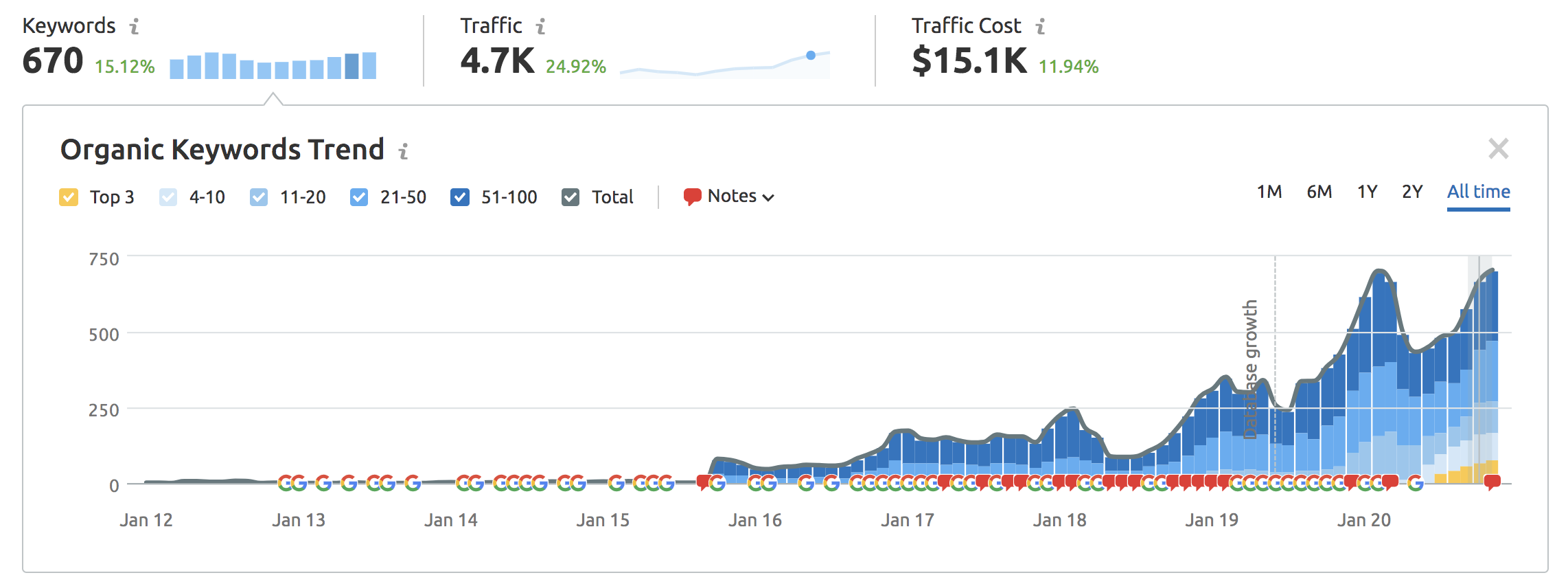
The shop newer to SEO has performed well with consumers but has also gained some corporate accounts. One shop had double digit sales growth, eclipsing previous years and the other shop increased their work force 25%. Both sites routinely rank in the local pack.
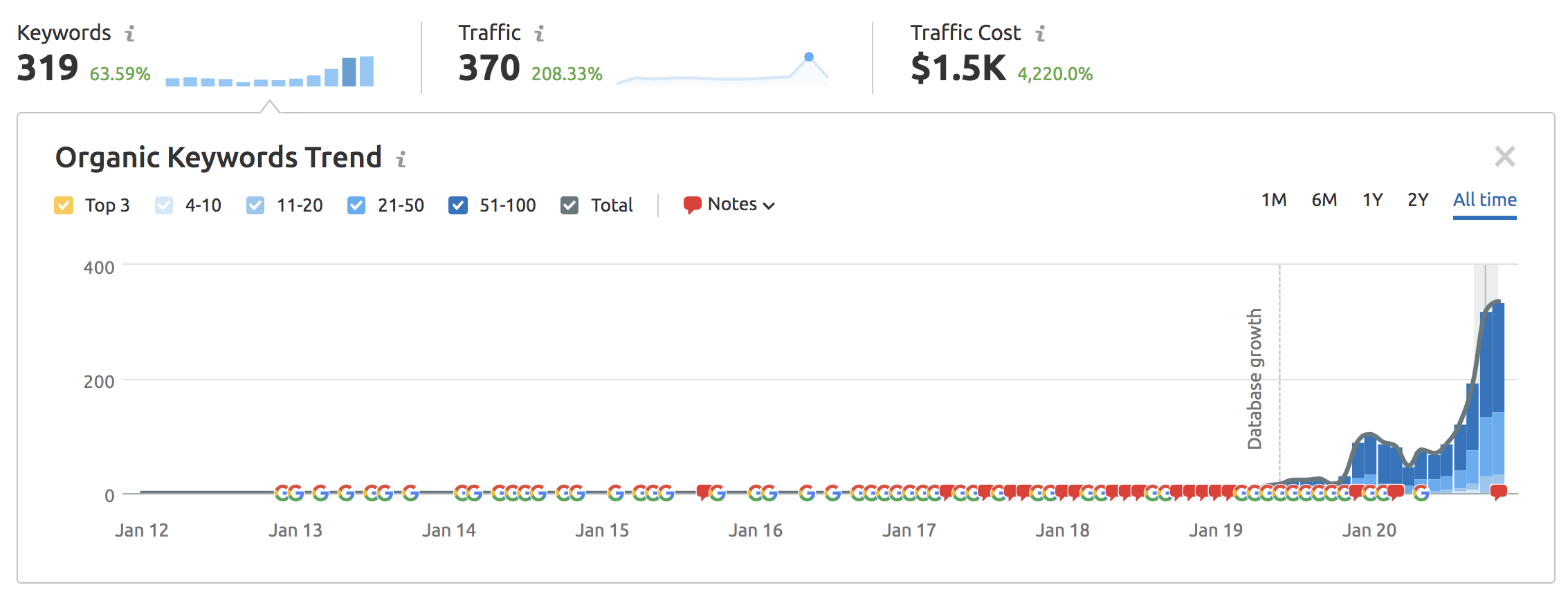
The graphs pictured above are reports from SEMRush. They measure organic traffic cost by multiplying the traffic volume generated by the competitive cost-per-click (CPC) of the related keyword. Suppose the phrase “auto repair near me” earned a high ranking and as a result drew site traffic of 100 organic visitors. Since that phrase has a CPC of $5.85 for a paid ad, the value of that traffic is pegged at $585 or $5.85 per visitor multiplied by 100 visitors.
If anything, this tends to understate the value of said traffic as organic visitors stay longer on a site, visit more pages, return more frequently and convert at a higher rate due to the intent of organic search. Indeed, one study has organic as being 46% more trustworthy than paid advertising. Besides, what is captured is the cost of the traffic, (when made equivalent to CPC). Ultimately the value is the increased brand awareness of your business and new customers buying your service. In this instance, a single auto body job could top $10,000 or a customer who comes in for one oil change, can become a lifetime customer for future oil changes, annual inspections, tire replacements, brake repair and alignments.
The graphs demonstrate it but to clarify: organic traffic for both sites has increased between three to five-fold. The value of the organic traffic exceeds the monthly SEO investment; the value continues to grow while their budget is level.
While it is good to let the metrics speak for themselves, we know that not all things can be measured and sometimes, things have to be evaluated qualitatively. We mentioned in a previous post several reasons why good content is its own reward as it demonstrates thought leadership, builds a community of individuals who share similar interests, and clearly defines your brand. Strong search engine result page (SERP) rankings feed a positive feedback loop by attracting more traffic, more time on site, more page views, more trial, and more backlinks, thereby increasing the site authority and boosting other site content. Related to the client with the longer SEO history, the split between branded and discovery traffic has changed from 98% / 2% prior to program inception to 18% / 82%. Branded traffic describes searches by people who “knew you” as your name is included in their search. Discovery traffic describe searches by people “new to you” who search a higher-volume, generic term that describes a service provided by you. Think of the former as “Joe’s Ristorante” and the latter as “Pizza and Pasta near me”.
Daily Google searches have almost doubled since the start of the pandemic as more people work from home and the trust in results increases. This consumer trend shows no sign of abating. As a business, you know it is difficult to create awareness without being present where prospects are. Call us at (914) 348-9464 to begin discussing some strategies for increasing online lead generation.
Stay Connected